- open access
For the best view of this page, we recommend turning your device to portrait orientation.
Thank you!
Hendrikje Alpermann studied ethnology in Leipzig, Halle (Saale), and Tbilisi, as well as sociocultural studies at the European University Viadrina and the École d’Urbanisme de Paris. Her research focuses on everyday urban life and the interplay between architecture, urban planning, and society. She served as a research assistant at the Leibniz Institute for Spatial Social Research and the Institute of Geography and Sustainability at the University of Lausanne, as well as in the university administration at the European University Viadrina. She initiated and directed the transdisciplinary festival “wohn_komplex” to mark the 60th anniversary of Halle-Neustadt (together with Sabine Strobler and Karoline Stegemann).
Artists Unlimited ist Künstler*innen und Residency Initiative in Bielefeld. Seit 1985 bietet der Verein in einer alte Papierfabrik Platz zum gestalterischem Arbeiten und gemeinsamen Wohnen. Bisher erhielten über 100 Künstler:innen ein dreimonatiges Arbeitsstipendium des internationalen Gastateliers, in der eigenen Galerie waren seit 1987 bereits 400 Ausstellungen zu sehen.
Gilles Aubry is a Swiss artist, musician, and researcher based in Berlin who works at the intersection of visual art, sound, and research. The focus of his productions, compositions, installations, films, and performances lies on sound materiality, coloniality, and …ecology. His sound projects have been shown at international exhibitions such as documenta 14 and at the Museo Reina Sofía. He holds an MA in Sound Art from the Berlin University of the Arts (UdK) and a PhD in Social Anthropology from the University of Bern.
Lisa Anne Auerbach runs a modest propaganda empire from her home in Los Angeles. She knits subversive sweaters and banners, takes photos of overlooked landmarks, and brings small publications to the wider world. She has had solo exhibitions at the Gavlak Gallery in Los Angeles, Printed Matter, and the University of Michigan Museum of Art, among others.
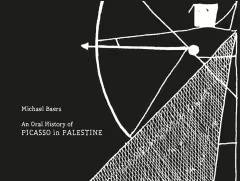
Michael Baers is an artist and author whose work focuses on the intersections between artistic practice, institutional and state policy, and national and international politics. His works often emerge from oral traditions and other forms of research. In 2014, he completed his doctorate as part of the practice-oriented doctoral program at the Academy of Fine Arts in Vienna. Since 2020, Baers has been an associate researcher at the Leibniz Center for Modern Orient Studies (ZMO) in Berlin.
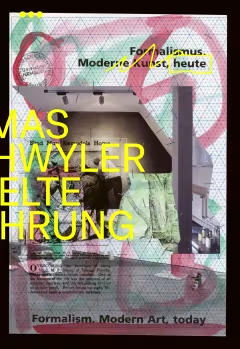
Thomas Baldischwyler works with a variety of media (music, film, photography, collage, painting, installation)—depending on the theme and context. His working process involves references to cultural-historical events in which the subjective frameworks of historiography are situated. His works have been featured in numerous national and international solo and group exhibitions. In 2010, he received the Westfälischer Kunstverein Münster’s Promotion Prize, and in 2017, the Hamburg Edwin Scharff Prize. After extended residencies in Basel, Rome, and Venice, he has been living and working in Hamburg again since 2022, where he runs, among other things, the artist-run record label Travel By Goods.
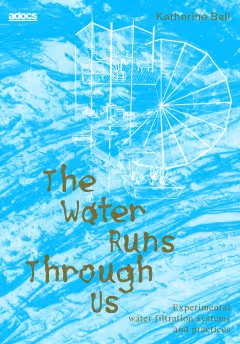
Katherine Ball is a habitat for fungi and bacteria located on planet Earth. Their artistic interventions practice the arts of living on a damaged planet and reimagine the infrastructure of everyday life. These have included: living in an off-grid floating island building mushroom filters to clean a polluted lake, bicycling across the USA looking for “solutions” to the climate crisis, and apprenticing with nature to learn the biological counterpart to civil disobedience.
Katherine has a Master in Fine Arts in Social Practice from Portland State University and studied at the School of Walls and Space in Copenhagen. Katherine is a founding member of Floating Berlin since its inception in 2018.
Sandra Bartoli is an architect and landscape architect. Her research focuses on places where nature and the city are intertwined, such as Berlin’s Tiergarten, a transgressive example of a site that leads to new definitions and models of what constitutes “urban” in the face of the challenges of the Anthropocene. In 2019, Bartoli co-edited the book *Tiergarten. Landscape of Transgression” (Park Books). From 2017 to 2018, Bartoli began working on the research topic “The Future Natural History of the City” as an endowed professor for Visionary Urban Forms at the Institute for Art and Architecture at the Academy of Fine Arts Vienna. Bartoli is currently a full professor at the Faculty of Architecture at Munich University of Applied Sciences.
Anke Becker is a visual artist and has been working in Berlin since 1991. Her artistic practice ranges from conceptual drawings and installations to visual poetry and participatory projects. She explores the presence and absence of language, line, and text in diverse ways. She is the founder of the international art and exhibition project Anonyme Zeichner, runs the visual poetry blog Economic Words, and is a founding member of the Damensalon, a network of female artists featuring monthly salon evenings with rotating guests.
Jochen Becker works as an author, curator, and lecturer, and is a co-founder of metroZones | Center for Urban Affairs and the station urbaner kulturen/nGbK. He curated “Chinafrika. under construction” (Graz, Leipzig, Weimar, Shenzhen, Nuremberg) and provided cultural-political, conceptual, and curatorial support for the relocation of Düsseldorf’s FFT Theater (2017–2022). Becker is active in the Urbane Praxis initiative.
Marieke Behne studied architecture at HafenCity University Hamburg and worked there in the Architecture and City department. She earned her doctorate on the modes of operation of experiential knowledge in architecture using the example of self-organized housing projects and is a co-founder of projektbuero Hamburg.
The artists Sabine Bitter & Helmut Weber, who live in Vancouver and Vienna, have been working since 1993 on projects that deal with cities, architecture, and the politics of representation and space. They work with the media of photography and video. In their research-oriented practice, they examine specific moments and logics of global urban change as they manifest in neighborhoods, architecture, and everyday life. Since 2004, they have been members of the cultural research collective Urban Subjects, together with Jeff Derksen.
Frieder Bohaumlitzky is a designer, curator, and political scientist. He designs, researches, and teaches on the political relevance of material culture. From 2017 to 2019, he was part of the Friedrich von Borries Project Office in Berlin, and from 2020 to 2023, he served as a research assistant at the Center for Design Research at HAW Hamburg. Since 2023, he has been running studio lose together with Ina Römling and Torben Kärschke, which collaboratively and speculatively explores the design of sociopolitical spaces of negotiation.
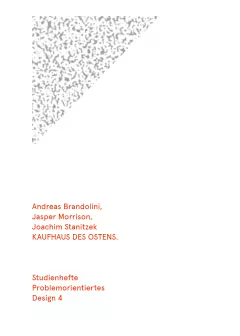
Andreas Brandolini studied architecture at the Technical University of Berlin (1973–1979) and worked as a designer and architect at Produktentwicklung Roericht in Ulm (1979–1981). Brandolini was a co-founder of the avant-garde New German Design movement of the 1980s; he set new standards with his “German Living Room” at documenta 8. From 1986 to 1993, he ran his own design studio in Berlin. In the late 1980s, Brandolini founded the firm “Utilism International” with Jasper Morrison and Axel Kufus, which focused on exhibition design and urban planning. Brandolini was co-editor of “Kaufhaus des Ostens” in 1984.
Amélie Brisson-Darveau is an artist, researcher, and doctoral candidate based in Tiohtiˆ:ke/Montréal. In her work, she explores the structural properties of shadows in literature, art, performance, cinema, and urbanism.
Christoph Brunner has a background in cultural and media studies as well as continental philosophy. He investigates the relationships between media, aesthetics, and politics, with a particular interest in post- and decolonial critiques of Western thought and a posthumanist decentering of the individual. He was a junior professor of cultural theory at Leuphana University Lüneburg (2016–2023); since 2023, he has been an assistant professor at the School of Philosophy at Erasmus University Rotterdam.
Paul Buckermann ist Soziologe, Kulturmanager und Autor und beschäftigt sich mit den Schnittstellen zwischen Kunst, Wissenschaft und Politik. Neben seiner wissenschaftlichen Tätigkeit ist er als Kulturjournalist tätig und verfasst Essays und Rezensionen für Publikationen wie u.a. WOZ, Jungle World, Texte zur Kunst. Als Kulturmanager und Kulturvermittler hat er in Institutionen wie Artists Unlimited, Neubad Luzern, Heidelberger Kunstverein, Oval Office Bar, KoFabrik und Künstlerhaus Dortmund gearbeitet.
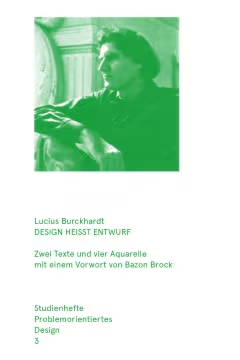
Lucius Burckhardt (1925–2003) held a Ph.D. in sociology. After serving as a visiting lecturer at the Ulm School of Design in 1959, he held several teaching positions and later served as a visiting lecturer in sociology at the Department of Architecture of the Swiss Federal Institute of Technology in Zurich from 1961 to 1973. At the same time, he served as editor-in-chief of the journal “Werk” from 1962 to 1972. From 1976 to 1983, Lucius Burckhardt was the first chairman of the German Werkbund, and from 1973 onward he taught as a professor of the socio-economics of urban systems at the University of Kassel. From 1987 to 1989, he was a member of the founding advisory board of the Saar College of Fine Arts, and from 1992 to 1994, he served as founding dean of the Faculty of Design at the Bauhaus University Weimar. His work was honored in 1994 with the Hessian Culture Prize for outstanding achievements in art, science, and cultural education, in 1995 with the Federal Prize for Design Promotion, and in 2001 with the Swiss Design Prize.
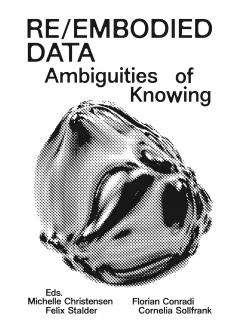
Michelle Christensen is a sociologist and designer serving as a visiting professor for Open Science/Critical Culture at the Technical University of Berlin and the Einstein Center Digital Future. Her work focuses on feminist/queer, decolonial, and post-anthropocentric approaches in design.
Marco Clausen studied history and philosophy and, together with Robert Shaw, co-founded the Prinzessinnengarten in Berlin’s Kreuzberg neighborhood. Since the foundation and development phase (2020), he has been part of the core team at the nonprofit Spore Foundation as a community facilitator.
Oliver Clemens is an architect. His work focuses on community housing projects, affordable rental housing, participatory planning, and urban and real estate development oriented toward the public good. As a member of the planning team at ExRotaprint gGmbH, he is working on the renovation and development of the historic site in Berlin’s Wedding district. Together with Sabine Horlitz, he heads the studio CHplus.
Florian Conradi is a designer and researcher who combines design and critical theories as an approach to design research. He is co-director of the research group “Design, Diversity and New Commons” at the Berlin University of the Arts within the Weizenbaum Institute.
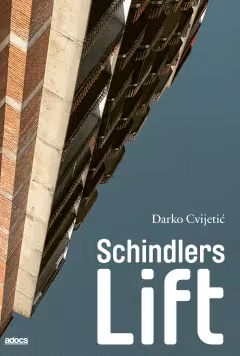
Darko Cvijetić was born in 1968 in Ljubija Rudnik, Bosnia and Herzegovina. He writes poetry and short stories and is a director and playwright at the theater in Prijedor. His poems have been translated into French, English, German, Slovenian, Hebrew, Albanian, Hungarian, Polish, Macedonian, and Yiddish. Since 2013, he has been editing the literary blog Hypomnemata. He is a member of the PEN Center of Bosnia and Herzegovina, the Writers’ Association of Bosnia and Herzegovina, and the Croatian Writers’ Association.
The Deichtorhallen Hamburg are dedicated to contemporary art and photography. With its three venues—the Halle für aktuelle Kunst, the Haus der Photographie, and the Sammlung Falckenberg—it is one of the largest exhibition venues of its kind in Europe.
The Deichtorhallen regularly serve as publishers or co-publishers of catalogs for the exhibitions of the Photography Triennial. For the 9th Hamburg Photography Triennial in 2026, titled “Alliance, Infinity, Love – in the Face of the Other,” the Deichtorhallen are publishing a box set that brings together twelve publications from Hamburg institutions and museums.
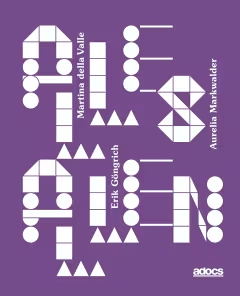
Martina della Valle creates images, situations, and photographs. Much like a darkroom, her artistic research is grounded in photographic techniques. In her work, she employs various media, which she combines with collaborative working methods to produce site-specific installations and printed works.
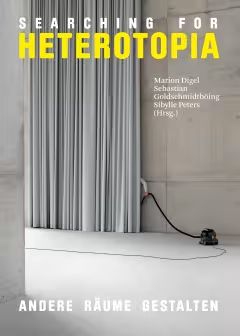
Marion Digel is an industrial designer and professor of Fundamentals of Industrial Design and Basic Design at the Folkwang University of the Arts. She studied at the University of Connecticut, earned her degree in industrial design from the Berlin University of the Arts (UdK), and ran her design studio, designmariondigel, in Nuremberg and later in Cologne (1992–2006). At the Folkwang University of the Arts, she was head of the Department of Industrial Design from 2007 to 2012 and dean of the Faculty of Design from 2013 to 2019. Marion Digel was a co-founder of the graduate program “Heterotopia”, where she led the Studio for Spatial Relations.
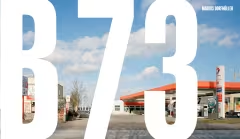
Markus Dorfmüller is a photographer specializing in architectural and urban photography. He lives and works in Hamburg.
Knut Ebeling is a philosopher, media theorist, and art critic. Since 2009, he has been a professor of media theory and aesthetics in the Department of Theory and History at the Weißensee Kunsthochschule Berlin. He lives and teaches in Berlin.
Ignacio Farías is Professor of Urban Anthropology at the Institute for European Ethnology and Director of the Georg Simmel Center for Urban Research at Humboldt University in Berlin. He works at the intersection of social and cultural anthropology, science and technology studies, and urban studies. Far’as understands ethnography as a creative, experimental practice of urban design.
Daniel Martin Feige teaches as a professor of philosophy and aesthetics in the Design Department at the State Academy of Fine Arts in Stuttgart.
Jesko Fezer works as an architect, author, designer, artist, and exhibition designer. In cooperation with ifau (Institute for Applied Urban Studies), he has realized architectural projects and is a co-founder of the research and exhibition design studio “Kooperative für Darstellungspolitik.” He is a professor of experimental design at the University of Fine Arts in Hamburg. He is co-editor of “An Architektur” and a partner in the Berlin-based thematic bookstore “Pro qm.” At adocs, he is co-editor of the series “Studienhefte problemorientiertes Design.”
Kim Förster works as an author, researcher, and lecturer. Since 2019, he has been working at the University of Manchester in the Architecture Department within the School of Education, Environment, and Development (SEED) as an architectural historian, researcher and educator with a transdisciplinary focus specializing in environmental and energy humanities, including politcal, economic, ecological, and geological issues of climate, energy, materials, and pollution.
Chup Friemert was born in Westhausen in 1947. He lives in Hamburg and Süderstapel. He studied product design at the State Academy of Fine Arts in Stuttgart, experimental environmental design at the State University of Fine Arts in Braunschweig, and journalism, philosophy, and economics at the Free University of Berlin. In 1977, he received his diploma from the State Academy of Fine Arts in Braunschweig with a thesis titled “Humanization of Work and Trade Unions.” Beginning in 1971, Friemert taught courses on commodity aesthetics, design history, and design theory at various universities. From 1984 to 2012, Chup Friemert was a professor of design history and design theory at the University of Fine Arts in Hamburg.
Hermann Funke (1932–2023) studied architecture and urban planning at the Technical University of Braunschweig from 1952 to 1956; in 1956, he received his diploma under the supervision of urban planner Johannes Göderitz; in 1965, he earned his doctorate with the thesis “Office Buildings + Office Operations” at the Technical University of Braunschweig. He worked at the chair and in the office of Friedrich Wilhelm Kraemer, as well as in the office of architect Godber Nissen in Hamburg. Since 1965, he worked as a freelance architect, planner, and journalist in Hamburg. He retired in 2002.
Rahima Gambo is a multimedia artist. She studied social sciences in Manchester and London and journalism in New York City. After working as a photojournalist, she returned to Abuja, Nigeria, and began her artistic career with videos embedded in spatial installations that incorporate drawings, photographs, found objects, and plants.
Sebastian Goldschmidtböing is a designer and researcher who lives and works in Cologne and Essen. He has a background as a master craftsman and several years of experience in research and development for the German automotive industry. He studied design at the Design Academy Eindhoven (BDes) and at the Berlin University of the Arts (M.A.). He has worked for design studios such as Aldo Bakker Studio (Amsterdam) and Studioilse (London). Since 2017, Sebastian Goldschmidtböing has been researching, working, and teaching at the Faculty of Industrial Design at the Folkwang University of the Arts in Essen.
Philipp Goll completed studies in media studies, Slavic studies, and European ethnology, as well as a Ph.D. in cultural studies. He is a freelance author and cultural researcher, inspired by artistic research, non-hegemonic knowledge practices, and dance.
Erik Göngrich is an artist, architect, and curator. His sculptures, performances, installations, photographs, and publications reflect on the uses and transformations of urban space. Together with Berlin’s Mitkunstzentrale at the Haus der Statistik, he initiated a workshop for collective knowledge production. By recycling materials, ideas, and stories, his works address material cycles, art, the public sphere, and society in times of climate emergency.
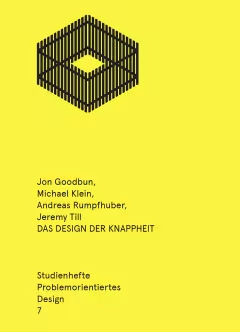
Jon Goodbun teaches at the Royal College of Art in London (MA Environmental Architecture), at the University of Westminster (MSc Advanced Environmental Design), and at UCL Bartlett (MArch). His publications include contributions on ecological systems theory, spatial knowledge, and the architecture of the extended mind.
Matthias Görlich is a communication designer. He is a professor of Communication Design/Information Design at Burg Giebichenstein University of Art and Design Halle. Since 2000, he has been working with his studio in the fields of design and concept development for, among others, various art and cultural institutions in Germany and abroad, UNRWA (United Nations) in Jordan, Estudio Teddy Cruz in San Diego, and Cohabitation Strategies in New York. He is co-editor of “Institution Building” on spatial strategies of art institutions (with Nikolaus Hirsch, Philipp Misselwitz, and Markus Miessen) as well as the “Civic City Cahiers” on the role of design in the development of a social city (with Jesko Fezer). At adocs Verlag, he is co-editor of the series “Studienhefte problemorientiertes Design".
Justus Griesenberg is an architect. As a member of the Architecture and City department at HafenCity University Hamburg, he developed “Cooperative Standards” for situational architecture together with Marieke Behne and Christoph Heinemann.
Markus Grob (1952–2021) traveled to Afghanistan in 1972/73, began studying Islamic Studies (which he did not complete), and traveled to Egypt in 1976/77. Starting in 1978, he studied architecture in Zurich; in 1984, he received his diploma from ETH and began his first practice with the renovation of Haus S. in Zug. From 1988 onward, he worked in Vienna as an architect in Adolf Krischanitz’s studio. In 1996, he was at the Akademie Schloss Solitude in Stuttgart, after which he was appointed to the professorship of architecture at the HFG Karlsruhe and collaborated with an architectural firm in Zurich. Since 1999, he created stage installations for the performance group "Die Bairishe Geisha" in Munich; in 2001, he completed a residential renovation in Barcelona; in 2004, he curated the exhibition “Kannitverstan” at the Badischer Kunstverein in Karlsruhe; and in 2008, he oversaw the renovation of a townhouse in Hamburg-St. Pauli. In 2012/13, he gave a winter lecture at the Weißensee Academy of Art on the relationship between architecture, urban space, and politics in the periods 1789 ff., 1918 ff., and 1948 ff. Publications: “Tun der Architektur,” Grundzüge der Architekturtheorie, Edition Solitude 1996; “Gründe, dass es eine Stadt nicht mehr geben kann,” on the problem of post-feudal urban planning, Raketenstation Hombroich 2004.
Kathrin Grotz has been Deputy Director of the Institute for Museum Research at the State Museums of Berlin—Prussian Cultural Heritage Foundation since 2020.
Anke Hagemann is a researcher in architecture and urban studies. Since 2021, she has been acting professor at the Chair of International Urbanism and Design (Habitat Unit) at TU Berlin. Previously, she taught at institutions including ETH Zurich, HCU Hamburg and BTU Cottbus. Her current research topics include the global circulation of goods and urban space, metabolisms between city and countryside, as well as extended urbanisation and public participation in strategic planning processes.
Moritz Hannemann studied theater and literary studies. He was a research assistant at the Institute of Theater Studies at Ruhr University Bochum and a dramaturg at the Forum Freies Theater (FFT) in Düsseldorf. He was involved in the conception of the urban laboratory “Place Internationale,” which linked the FFT’s relocation with the 150th anniversary of the Paris Commune. Within this framework, he conceived the “Lefebvre Workshop” together with Klaus Ronneberger and Laura Strack, which resulted in the publication “Baustelle Commune.” Since the 2024/2025 season, he has been a dramaturg at the Schauspielhaus Bochum.
Christian Hanussek works as an artist, author, and curator and is a member of metroZones – Center for Urban Affairs in Berlin. He studied painting and art theory at the Städelschule in Frankfurt and at “Ateliers ’63” in Haarlem, Netherlands. His artistic work encompasses and combines painting and drawing as well as film and video.
Gabu Heindl is a professor and head of the department “Architecture, City, Economy – Construction Industry and Project Development” at the University of Kassel. As an architect and urban planner, she runs the firm GABU Heindl Architektur in Vienna. She practices, researches, and publishes with a focus on housing, public space, and issues of distribution in architecture and urban planning. Her most recent publications include the monograph “Urban Conflicts. Radical Democracy in Architecture and Urban Planning” (2020) and the research report “A Just City Is a Must!” (2022).
Christoph Heinemann is an architect and has been a member of the Institute for Applied Urban Studies (ifau) since 1998. As a professor in the Department of Architecture and Urban Studies at HafenCity University Hamburg (2017–2022), he explored situational and relational dispositions in the urban sphere of action.
Marcel Hénaff (1942–2018), philosopher and anthropologist, was a professor at the University of California, San Diego. He is the author of “The Price of Truth: Gift, Money, and Philosophy” (2009), for which he was awarded the Grand Prix Moron by the Académie française in 2002 for the French original.
Naomi Hennig lives and works as a cultural producer in Berlin and London. She is involved in various models of collaborative cultural production, including nGbK and District Berlin. As part of her PhD project, she is researching the geopolitics of neoliberalism and its spatial-ecological implications.
Paula Hildebrandt is an author and filmmaker who combines performative action, experimental writing, and photography in her work. She studied political science at the Free University of Berlin, global political economy at the University of Sussex, and “Brokering Cross-Sector Partnerships” in Cambridge. From 2002 to 2007, she worked as a project manager for the United Nations Development Programme (UNDP) and the German Society for International Cooperation (GIZ). She was a co-founder of the interdisciplinary sustainability network “3plusX” and co-curator of “Über Lebenskunst” at the House of World Cultures in Berlin. At HCU Hamburg, she coordinated the graduate program “Performing Citizenship” (2015–2017).
Carolin Höfler is a professor of design theory and research at the Cologne International School of Design (KISD) at the Technical University of Cologne. Since 2018, she has been the spokesperson for the interdisciplinary research center “Echtzeitstadt – Real-Time City” at the Technical University of Cologne, which she co-founded.
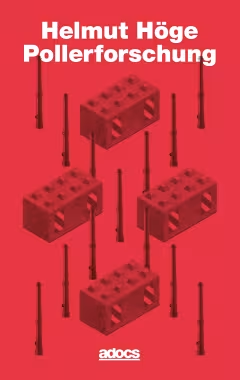
Helmut Höge is a freelance writer and temporary janitor at the daily newspaper “taz.” He lives in Berlin and writes regularly on his blog “Hier spricht der Aushilfshausmeister!” as well as the column “Wirtschaftsweisen” (“taz Berlin”) and the column “Wirtschaft als das Leben selbst” (“Junge Welt”). Most recently, he published the 11th volume of his animal book series “Kleiner Brehm” on corvids (Peter Engstler Verlag) as well as “Die lustige Tierwelt und ihre ernste Erforschung” (Westend Verlag) in 2018. In 2014, he was awarded the Ben Witter Prize.
Sabine Horlitz is an architect and urban researcher. Her research focuses on critical urban studies, with a particular interest in non-profit ownership models. She is a co-founder of the Stadtbodenstiftung, which is inspired by the Community Land Trust model, and a member of the foundation’s board. Together with Oliver Clemens, she runs studio CHplus.
Anne Huffschmid is a cultural studies scholar, author (text, photography, film), and curator. She researches, publishes, and teaches on urban issues, social memory processes, and the materialization of violence, with a particular interest in discourse and image studies, audiovisual research, and experimental methods, formats, and narratives in the cultural and social sciences. Latin America, particularly Mexico, is a central point of reference in her work.
Anna Jehle ist freie Kuratorin. Sie war langjähriges Vorstandsmitglied der Initiative Artists Unlimited, Bielefeld. Seit 2020 leitet sie gemeinsam mit Juliane Schickedanz die Kunsthalle Osnabrück.
Anita Kaspar is an architect and designer. She works in the fields of architecture, exhibition design, and spatial research. Together with Jesko Fezer, Andreas Müller, Fynn-Morten Heyer, and Maximilian Weydringer, she runs the research and design studio Kooperative für Darstellungspolitik. The studio explores how architecture and spatial design can bring social and political issues to light.
Kayoung Kim is active in collaborative projects that combine design with sociopolitical processes. In her practice, she focuses on community-oriented initiatives in urban spaces between Hamburg and Seoul.
Michael Klein works at the intersection of architecture, art, and urbanism, currently at the Department of Housing and Design and the Department of Urban Planning at TU Wien, as well as for “dérive – Association for Urban Research.” His work focuses on housing, history, political theory, and education.
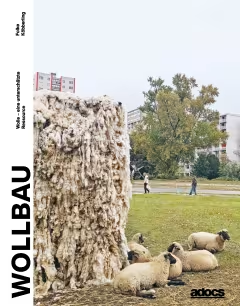
Folke Köbberling is an artist and professor. She studied fine arts and architecture at the Kunsthochschule Kassel and the Berlin University of the Arts. Köbberling has taught at various universities since 2006, including the Royal College of Art in London and the ArtCenter College of Design in Pasadena. Since 2016, she has been a professor at the Institute for Architecture-Related Art at the Technical University of Braunschweig. Together with the artist Martin Kaltwasser, Köbberling has realized numerous projects in public spaces between 2002 and 2022. Her artistic works have received multiple awards and have been exhibited in international venues.
Isabella Kohlhuber is a media artist and communication designer. Her work focuses in particular on the role of writing and the significance of knowledge in the digital age. As a partner of Dirck Möllmann, she has accompanied the entire “Hamburg Maschine” project in its development and implementation from the very beginning.
Kollektiv Quotidien was established in 2017 by a group of students, artists, researchers, and theorists of the MA-programme “Spatial Strategies” at weißensee kunsthochschule berlin, Germany. Its first inception was the organisation of the symposium “Alltageintagaus – A Lefebvre Symposium About the Right to the City”, which took place at MehringHof and Club Miami in Kreuzberg, Berlin.
The Kollektiv Quotidien consists of Victoria Claire Anderson, Elisa T. Bertuzzo, Johanna Gilje, Lin Nowicki, Uroš Pajović, and Daniele Tognozzi.
Kooperative für Darstellungspolitik is a studio for exhibition design that conceives of exhibitions as discursive spaces whose design supports social negotiation processes. It was founded in Berlin in 2008 by Jesko Fezer, Anita Kaspar, and Andreas Müller to conduct practical research into questions of the public representation of political and cultural concerns. Fezer, Kaspar, and Müller are former co-editors of the journal “An Architektur” and teach experimental design, urban planning, and exhibition design at various universities. Together, they design exhibitions for institutions including the Haus der Kulturen der Welt, Casco, Albertinum, Moderna Museet, documenta 14, SESC Pompeia, the Neue Gesellschaft für bildende Kunst, Kunstraum Kreuzberg/Bethanien, Bergen Kunsthall, SAVVY Contemporary, the Goethe-Institut, and the Venice Biennale.
Linda Lackner is an architect and architectural theorist. She studied architecture at the Vienna University of Technology (TU Wien) and the Academy of Fine Arts Vienna. She has served as a research assistant on various projects, including the FWF-funded PEEK project “Curating the Urban” (2017–2019), and worked as an editorial assistant at ARCH+. She is a member of the interdisciplinary association “Team Wien – Initiative for Collaborative Urban Development.” In her work, she addresses issues such as visibility, mechanisms of inclusion and exclusion, and the manifestation of ideologies and politics of the past through architecture and urban planning measures.
Heimo Lattner studied at the Academy of Fine Arts Vienna and at the Whitney Independent Study Program, NY. Co-director of the General Public Berlin project space (2005–2015). Since 2015, editorial board member of the Berliner Hefte zur Geschichte und Gegenwart der Stadt and co-editor of Ibid. – staged readings from documents on Berlin’s urban and cultural policy. Since 2017, he has been conducting research on autonomy and functionalization at the Berlin University of the Arts (UdK). He held a teaching position at the Institute for History and Theory at the Weißensee Academy of Art Berlin (2017–2018).
Oliver Leistert is a media scholar specializing in media dynamics and social change. His research focuses on the connection between media change and climate change, from both a social and an ecological perspective. In 2014, he won the Surveillance & Society Book Award for his dissertation on the impact of surveillance on social movements in various countries. Since 2024, he has been a university assistant at the University of Innsbruck at the Institute for Media, Society, and Communication.
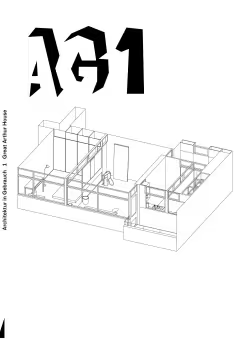
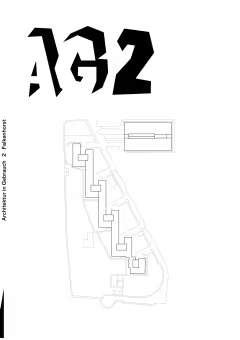
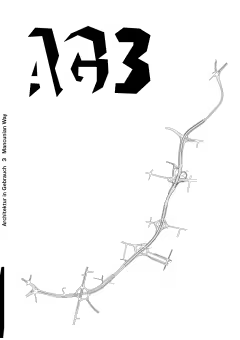
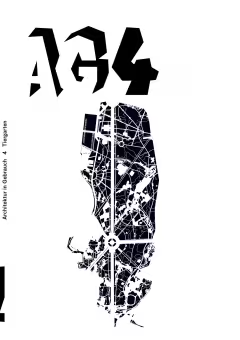
Silvan Linden is an architect and co-editor of the ongoing series “AG – Architektur in Gebrauch” (adocs 2021), an architecture zine launched in 2014 that explores concepts of “use” as an aesthetic category shaping the development and transformation of architectural spaces. Linden was a visiting professor at the Academy of Fine Arts in Nuremberg; he has taught at Greenwich University in London and at the Technical University of Braunschweig. He is currently an associate professor researching typologies in architecture and urban planning at the Technical University of Berlin.
Diana Lucas-Drogan is an architect and artist. In her artistic work, she maps and performs cultural and political spatial codes in critical cartographies and reflects on performative ethnographic methods of representing the field of research. She has taught at the Technical University of Braunschweig (GTAS), among other institutions, and headed the municipal department for urban planning, economic development, and building law in Waren/Müritz. She currently directs the Digital Innovation and Learning Lab at the Eberswalde University for Sustainable Development.
Annette Maechtel lives and works as an independent curator, art and cultural scholar, and lecturer in Berlin. Her research focuses explicitly on Berlin as a political and discursive space. Her curatorial approach is research-based, mostly collective, and utilizes a wide variety of media and formats—including temporary spaces, publications, walks, radio programs, and institutional exhibitions. In 2018, she completed her dissertation at the HGB Leipzig. Since 2017, she has been a research associate in the Einstein Research Project “Autonomy and Functionalization” at the UdK Berlin, Institute for the History and Theory of Design.
Claudia Mareis is a designer as well as a scholar of design and cultural studies. Since April 2021, she has been a professor of design and history of knowledge at the Institute for Cultural Studies at Humboldt University in Berlin. Since 2019, she has been co-spokesperson for the interdisciplinary Cluster of Excellence “Matters of Activity. Image Space Material” at Humboldt University in Berlin. Her research focuses on 20th-century design history and methodology, knowledge cultures in design, experimental design and media practices, the cultural history of creativity and creative practices, as well as design and material politics.
Aurelia Markwalder works with Luise Bartels under the name “Ernst und Mund” as a freelance graphic designer and type designer. In 2017, they founded the multi-award-winning studio “More Impression” in Leipzig. Since 2024, she has been an artistic collaborator for typography, typesetting, and printing at the HGB Leipzig
Felix Marlow studied architecture and European ethnology in Hamburg and Berlin and is interested in urban planning as part of solidarity-building initiatives. From 2022 to 2024, he conducted research as a visiting scholar at the Chair of Urban Anthropology at Humboldt University in Berlin on model projects for cooperative, public-good-oriented urban development. He is currently working on the team of the Working and Coordination Structure for Public-Good-Oriented Urban Development (AKS Gemeinwohl), an interface between administration, civil society, and politics for public-good-oriented urban development.
Ralo Mayer explores the forms and temporalities of social change, as well as concepts of ecology beyond the crumbling dichotomy of nature and society. His multidisciplinary projects often revolve around objects of space exploration, outer space, and the science fiction of everyday life, weaving their stories together through the multifaceted notion of the plot. Mayer presents his work at international exhibitions, film festivals, and conferences, and has proudly identified as a meteorite licker since 2021. In 2024, he was awarded a postdoctoral fellowship from the Austrian Academy of Sciences for his project Plots of Un·Earthing, which investigates human engagements with extraterrestrial resources.
Ramia Mazé worked as a trained designer and architect in design consulting firms and in corporate research in the U.S. and Europe. She has led, published, and exhibited within the framework of interdisciplinary and international research projects in the fields of politically engaged design, feminist design studies, sustainable development, smart materials, and interactive spaces. She is a professor of Design for Social Innovation and Sustainability at the London College of Communication, University of the Arts London (UAL). From 2016 to 2024, she served as editor of the leading academic journal "Design Issues".
Johanna Mehl works as a cultural studies scholar at the Chair of Digital Cultures at TU Dresden. As a scholar, designer, and educator, she is interested in design as a culture of knowledge and its intersections with environmental history, cybernetics, systems theory, and media theory. She is a member of the editorial advisory board of the “Design+Posthumanism Network” and part of the research group “Against Catastrophe".
metroZones – Center for Urban Affairs e.V. was founded in Berlin in 2007 as an independent association for critical urban research. At the intersections of art, science, and politics, metroZones combines research and knowledge-production approaches, cultural and curatorial practices, and political interventions in its projects. The goal is to bring urban issues, everyday life, and conflicts into the public discourse—and to politicize them. To this end, metroZones relies on transnational, interdisciplinary, and institutional collaborations. Currently metroZones’ members are: Jochen Becker (curator and critic), Christian Hanussek (artist and curator), Anne Huffschmid (cultural scientist and author), Stephan Lanz (urbanist and curator), Diana Lucas-Drogan (artist and architect), Oliver Pohlisch (cultural scientist and journalist), Katja Reichard (Pro qm), Erwin Riedmann (social & computer scientist), Kathrin Wildner (urban ethnographer and curator).
Eva Moldenhauer (1934–2019) translated French-language literary and academic texts into German. She received a number of awards and prizes for her work. In 2012, she was awarded the Prix de l’Académie de Berlin for revitalizing and deepening German-French relations.
Andreas Müller works as an architect and exhibition designer in practice, research, and teaching. His work is driven by an interest in the communicative and transformative potential of designed space. He designs and creates exhibitions as discursive social spaces in which meaning is generated, renegotiated, shifted, and occasionally undermined. He is a co-founder of the research and design studio Kooperative für Darstellungspolitik.
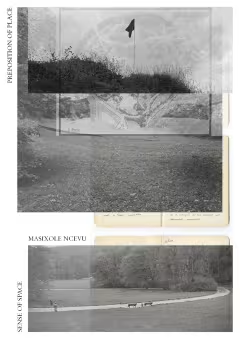
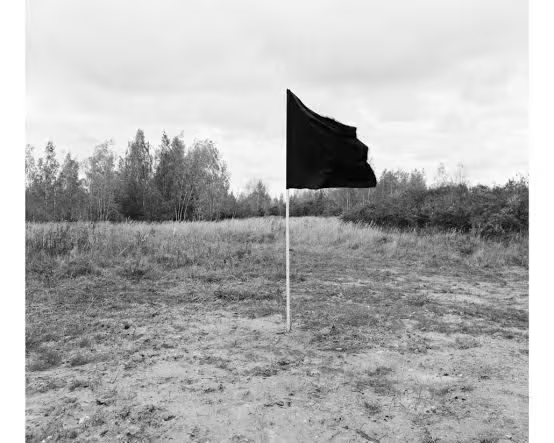
Masixole Ncevu is a South African artist living in Leipzig. His work is inspired by the immaterial world, postcolonial theory, and various decolonial ideologies. Masixole Ncevu integrates various media such as photography, film, drawings, and sound into his work. He uses photography as a tool to gain narrative insights.
Object Space Agency is an interdisciplinary research group at the “Matters of Activity” Cluster of Excellence at Humboldt University in Berlin. It focuses on active materials and their tangible conceptual and environmental aspects. Through exhibitions and collections, the group explores how materials that are both stable and ephemeral reveal their activity in time and space.
Morton Paul ist Literatur- und Kulturwissenschaftler. Nach seiner Promotion in Konstanz (2018) arbeitete er als Lektor u.a. bei Matthes & Seitz und dem August Verlag. Aktuell forscht er zur Geschichte des Freudomarxismus und zu Faschismustheorien. Seit 2023 ist er wissenschaftlicher Mitarbeiter am Kulturwissenschaftlichen Institut Essen (KWI).
Dagmar Pelger is an architect and urban planner. She teaches and conducts research on mapping methods as collaborative design tools and on models of communal urban space production, ranging from landscape to neighborhood. Since 2017, she has been part of the planning cooperative coopdisco Berlin.
Sibylle Peters is a researcher, artist, and theater director living in Hamburg. She conceives and leads participatory art-based research projects. She holds a Ph.D. in literary and media theory and is currently working on her habilitation thesis, a study on the lecture as performance. Sibylle Peters is co-founder and artistic director of the Fundus Theater / Theatre of Research in Hamburg (since 2001). Her current work and publications include transgenerational live art, performing citizenship, hydrarchy & radical seafaring, the art of being many, interspecies zones of equality, heterosexuality, creative destruction, improbability drives, and paralogistics.
Sven Quadflieg studied design and visual communication at the Folkwang University of the Arts in Essen and the Zurich University of the Arts, and earned his doctorate at the HFBK Hamburg. He has taught at various universities and is currently a professor at the HSHL in Hamm, where he focuses primarily on the design of information and interaction. His research interests include the interdependencies between design and society, political design, and transformative design.
Oleksiy Radynski is a Ukrainian filmmaker, author, and co-founder of Kinotron Group. His films experiment with documentary forms and practices of political cinema. They have been shown at film festivals and in exhibition contexts worldwide. Radynski is currently focusing on investigating the toxic legacy of Russian settler colonialism in Northern Eurasia and its imperial wars, including the ongoing Russian invasion of Ukraine.
Patricia Rahemipour has been Director of the Institute for Museum Research at the State Museums of Berlin—Prussian Cultural Heritage Foundation since 2019.
Andreas Reckwitz is a sociologist and cultural studies scholar. He is a professor of general sociology and cultural sociology at Humboldt University in Berlin. Reckwitz has been instrumental in advancing the development of praxeology as a comprehensive social and cultural theory, a perspective that also underpins his influential work on subjectivation and creativity.
Johan Redström is a professor of design at the Institute of Design at Umeå University in Sweden. Previously, he was director of studies at the Interactive Institute and held a research professorship at the Center for Design Research at the Royal Academy of Fine Arts, School of Architecture, Denmark. In 2006, he received the Design Studies Award, and in 2009, he was elected a Fellow of the Design Research Society.
Marinus Reuter is a photographer, author, and researcher. He researches post-phenomenological aesthetics and documentary photography and examines the common ground on which the mismatch between socially expanded regimes of representation and singular positioning manifests itself in politics and aesthetics. His own work focuses on logistics and service capital and a sociality dominated by distributive techniques.
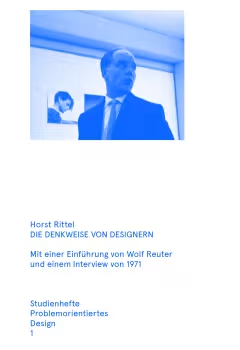
Horst Rittel (1930–1990) studied mathematics and theoretical physics in Göttingen from 1949 to 1954 and subsequently worked as a mathematician and physicist at Maschinenfabrik Deutschland AG in Dortmund until 1957. In 1958, he joined the Social Research Center at the University of Münster (WWU), where he studied mathematics and sociology. From 1958 to 1963, he taught methodology, information theory, and mathematical operations analysis at the Ulm School of Design (HfG Ulm), among other subjects, and became one of the leading voices advocating for a scientific analysis of design. Beginning in 1961, Rittel was a member of the Study Group for Systems Research in Heidelberg, as well as the initiator and leading scientist of numerous projects for the German Bundestag, the Bundesrat, and the OECD, among others. Following the 1962 Conference on Design Methods in London, Horst Rittel was one of the founding members of the Design Methods Movement. In 1963, he was appointed to the University of California, Berkeley, where he helped establish the Design Methods Group and the “DMG Journal” in 1967. From 1973 to 1990, Rittel was director and professor at the Institute for the Fundamentals of Planning at the University of Stuttgart.
Drehli Robnik is an essayist and theory consultant on politics, film, and history, as well as an edutainer, disc jockey, and music event organizer (Sonntag’sdisco). He is a (co-)editor of books on Siegfried Kracauer, the X-Men, and male violence in the domestic thriller (2022, with Joachim Schätz), as well as the author of monographs on anti-Nazi resistance, Jacques Rancière, control horror cinema, pandemic feature films, and popular cinema and politics.
Jens Röhm (1968–2010) studied visual communication at the HFBK Hamburg. He worked as a musician and film sound engineer and was a co-founder of the composer collective Nelly Boyd, which collaborated with musicians such as Alvin Lucier and Phil Niblock.
Klaus Ronneberger (1950–2025) studied social pedagogy in Würzburg and worked in an alternative record store. In Frankfurt am Main, he studied cultural anthropology and European ethnology, sociology, and political science. After many years of collaboration at the Institute for Social Research in Frankfurt am Main, he worked as a freelance journalist. Although he did not pursue a traditional academic career, Ronneberger had a significant influence on critical urban studies and urban activist movements. He was a member of the urban research group “spacelab,” was involved in Frankfurt initiatives such as Nitribitt and Kanak Attak, and participated in research projects such as “Shrinking Cities.”
Michael Rottmann is an art and media scholar. He studied art education, art history, mathematics, and philosophy in Stuttgart, Vienna, and Berlin. He was a research assistant at the Ludwigsburg University of Education as well as a curator at mumok and the Vienna University of Technology. He subsequently worked at the DFG Research Training Group “Schriftbildlichkeit” at Freie Universität Berlin. There, he earned his doctorate in 2013 with a dissertation on the relationship between art in New York around 1960 and mathematics. He has taught in Vienna, Graz, and Linz. From 2018 to 2022, he was a senior researcher at the Academy of Art and Design Basel.
Andreas Rumpfhuber is an architect and theorist. His research focuses on the changing aesthetic practice of architecture in relation to new economies. He has served as a visiting and adjunct professor at institutions including the Muthesius Academy of Fine Arts in Kiel, the State Academy of Fine Arts in Stuttgart, the Vienna University of Technology, and the Academy of Fine Arts in Vienna. He currently teaches at the Institute for Architectural Theory and History of Architecture at the University of Innsbruck.
Joseph Rustom is an architect whose research focuses on urban history. In collaboration with Lebanese architectural firms, he has led several conservation and restoration projects, including the Omari Mosque and the Archaeological Museum at the American University of Beirut, as well as the Soap Museum in Saida. He taught urban history and cultural heritage at the Faculty of Architecture of the Lebanese Academy of Fine Arts. He is currently the director of the library at Saint Joseph University in Beirut.
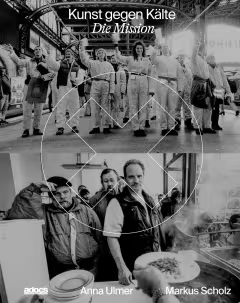
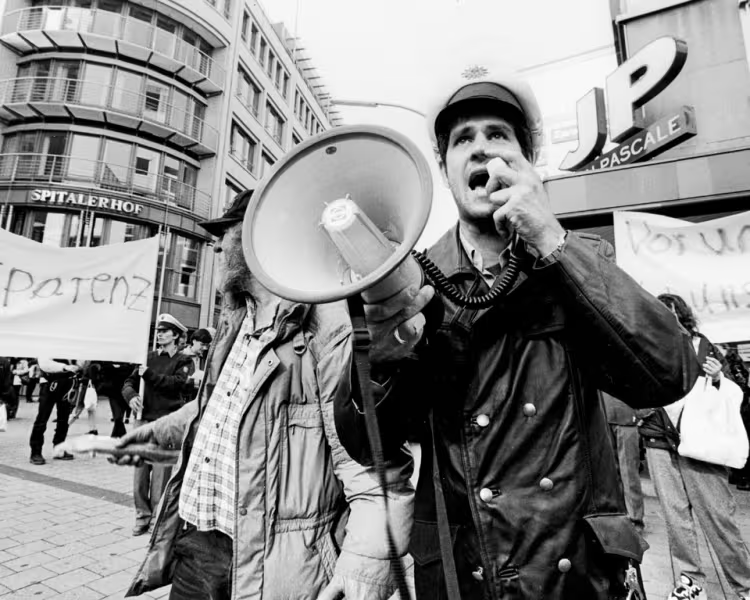
Markus Scholz studied social work with foreign nationals in a pilot program in Hamburg before turning to photojournalism as a self-taught photographer. First as a freelance theater photographer, then as a staff editor and photographer for *taz-Hamburg*, he documented events in the greater Hamburg area. Today, he is once again working as a freelance photographer for the German Press Agency (dpa) throughout northern Germany. What began as a journalistic photo assignment titled “THE MISSION” on an otherwise uneventful Sunday afternoon in 1997 turned into a project lasting several years, marked by solidarity and personal growth.
Adnan Softić is an author, visual artist, and director. He studied film and aesthetics at the HFBK Hamburg. His work explores historical themes and issues of the politics of memory. As the artist duo “Studio Softić,” together with Nina Softić, they have presented numerous installations and multimedia exhibitions both in Germany and abroad. In 2016–2017, they received the Villa Massimo Fellowship in Rome.
Cornelia Sollfrank is an artist, researcher, and author. Recurring themes in her artistic and scholarly practice include digital cultures, new forms of (political) self-organization, critical authorship, the aesthetics of the commons, and techno-feminist practice and theory.
Åsa Sonjasdotter is an artist, re-searcher, writer, and social organiser, living on the island of Ven, Sweden, and in the city of Berlin, Germany.
Barbara Herschel, Kaspar Jamme, Felix Künkel, and Justus Schweer) bring together experience in spatial practices such as architecture, landscape architecture, urban planning, academic teaching, collaboration with civil society actors, and public administration.They understand relational research as a way to examine space as a network of relationships, dynamics, and processes. With the founding of the Space of Relational Research, they seek to establish a critical research practice that traces connections in space, questions the boundaries of architecture, and proposes new fields of work and collaborations.
Speculative Space (SpecSpace for short) was an experimental lab at the Center for Design Research at HAW Hamburg (2020–2023). The lab operated between physical and virtual space. In both, six or more hybrid designers, philosophers, and artists speculated on the rhizomatic relationship between design and research. SpecSpace are Anke Haarmann, Alice Lagaay, Tom Bieling, Torben Körschkes, Petja Ivanova, Frieder Bohaumilitzky and Barbro Scholz.
Felix Stalder is a professor of Digital Culture at the Zurich University of the Arts and led the research project “Latent Spaces – Performing Ambiguous Data.” His work focuses on the intersections of cultural, political, technological, and ecological dynamics.
Christian Stein is a postdoc at the Cluster of Excellence “Matters of Activity.” With a background in German studies and computer science, he combines technical and humanities perspectives. As a co-founder of gamelab.berlin, among other roles, he develops playful, interactive formats for knowledge transfer and conducts research on interface theory.
Hito Steyerl is an artist and professor of Contemporary Digital Media at the Academy of Fine Arts in Munich. Her work has been exhibited at venues including the Venice Biennale, the Museum of Contemporary Art in Los Angeles, and the Museum of Modern Art in New York. In her texts, performances, and essayistic documentary films, Hito Steyerl explores (digital) image production, postcolonial critique, and feminist logic of representation.
Laura Strack studied theater studies, Romance languages, and literary translation in Bochum, Düsseldorf, Palermo, and Tours. Today, she works at the intersection of theater, text, and theory. She is particularly interested in (conceptual) figures of the common, in social movements and critical forms, in theater as a place and in various spaces (e.g., city and countryside), in artistic ways of writing about finitude, and in translation as an existential-aesthetic practice. She translates literary and theoretical texts from French and Italian.
Jeremy Till is an architect and author. He heads Central Saint Martins College and serves as Vice Dean of the University of the Arts London. Among other works, he has published the books “Flexible Housing” (2007, with Tatjana Schneider), “Architecture Depends,” and “Spatial Agency” (2009 and 2011, with Nishat Awan and Tatjana Schneider). All three have been honored with the RIBA President’s Award for Research. Till curated the British Pavilion at the 2006 Venice Biennale and the 2013 Shenzhen Biennale of Urbanism/Architecture.
Marius Töpfer works on process-oriented architecture and urban production across various scales. He is co-founder of Mikropol, a self-organized neighborhood center, as well as projektbüro, a studio for architecture and urban design.
Transforming Solidarities is an interdisciplinary research group based in Berlin. Since 2021, members from the Technical University, the Free University, Humboldt University, and Charité – Universitätsmedizin Berlin have been collaborating. The group works in an exploratory, interdisciplinary, and transdisciplinary manner at the intersection of academia and urban society. It connects the expertise of six renowned research institutes in Berlin’s academic landscape with actors in urban society and cultural institutions.
Anna Ulmer works as a freelance designer and artist. After training as a carpenter, she studied design at art colleges in Kiel and Hamburg. Her practice is shaped collaboratively within the context of neighborhood initiatives, marginalized perspectives, and urban voids. In texts, designs, and collaboratively developed projects, she addresses questions of participation, the negotiation of urban spaces, and the role of art and design within them.
Anna Unterstab studied Experimental Design and Social Design at the HFBK Hamburg and the Angewandte Vienna, as well as Communication Design at Burg Halle and MOME Budapest. She works from a feminist and queer perspective and publishes critical design theory. In collective and locally situated design processes, she works interdisciplinarily at the intersection of design, education, and art. Themes in her work include empowerment, vulnerability, memory culture, critique of power, community, and care. In 2023, she was awarded the German Design Graduate Award in the “Society and Community” category.
Felix Vogel studierte Kunstwissenschaft, Medientheorie, Philosophie und Ästhetik an der Staatlichen Hochschule für Gestaltung Karlsruhe und an der Universidad Autónoma de Madrid. Seine Forschungsschwerpunkte sind Kunst-, Architektur- und Wissensgeschichte vom 18. Jahrhundert bis zur Gegenwart. Seit 2021 ist Professor für Kunst und Wissen an der Universität Kassel, mit einer Zweitmitgliedschaft an der Kunsthochschule und dem documenta Institut.
Rebecca Wall studied architecture and urban design in Weimar and Hamburg. As an urban practitioner, she works and conducts research at the intersection of activist, artistic, and planning-based urban production. From 2022 to 2025, she conducted research as a visiting scholar at the Chair of Urban Anthropology at Humboldt University on model projects of cooperative, public-interest-oriented urban development.
Anna-Lena Wenzel is an author and artist living in Berlin. After studying Applied Cultural Studies in Lüneburg, she earned her doctorate on “Border Crossings in Contemporary Art.” She runs the online magazine 99% Urban and hosts the monthly “Radio Salon for Everyday Life".
Kathrin Wildner is an urban researcher. She uses ethnographic and artistic methods—walking, listening, mapping—to explore the “production of the city” and thus understand the complex relationships between planning, perception, and the use of urban spaces. She teaches at international universities and, as a member of metroZones—Center for Urban Research, is involved in a variety of interdisciplinary publications, exhibitions, workshops, and other performative outreach formats. Since 2023, she has served as an editor at the independent adocs Verlag Hamburg.
Clemens Winkler is a professor of New Media at the HfS Ernst Busch Berlin and a design researcher at the Cluster of Excellence “Matters of Activity.” He is fascinated by the vulnerability and resilience of materiality as well as the human desire to control the environment. He has exhibited internationally and studied at the Royal College of Art in London and the MIT Media Lab, among other institutions.
Florian Wüst lives in Berlin as a freelance artist and film curator. His work explores social, economic, and technological progress in the modern era. The film programs he curates are shown at international art institutions, movie theaters, and festivals.
Paola Yacoub conducted her first experiments with automata in architecture and photography as an artist and architect. In collaboration with Michel Lasserre, she documented the changes in Lebanese territories during the war and in the postwar period. Her works are exhibited internationally, including at Kunst-Werke Berlin, the Venice Biennale, the Beirut Art Center, and the Haus der Kulturen der Welt in Berlin. From 2013 to 2018, she served as the founding director of the ARP (Artistic Research Practices) program at the Lebanese Academy of Fine Arts in Beirut.
Frauke Zabel explores the question of the political subject today as an artist. Her interest lies in an embodied approach to historical, political, and artistic strategies of resistance against the backdrop of a potential deconstruction of hegemonic readings of history(ies). Since 2018, she has been a member of the committee of Florida Lothringer 13, an art space in the city of Munich.
Lisa Zander is co-founder of PlanBude and Mikropol. Her work addresses the democratization of planning processes and the critical appropriation of space. In 2020, she founded projektbüro, a studio for architecture and urban design in Hamburg.