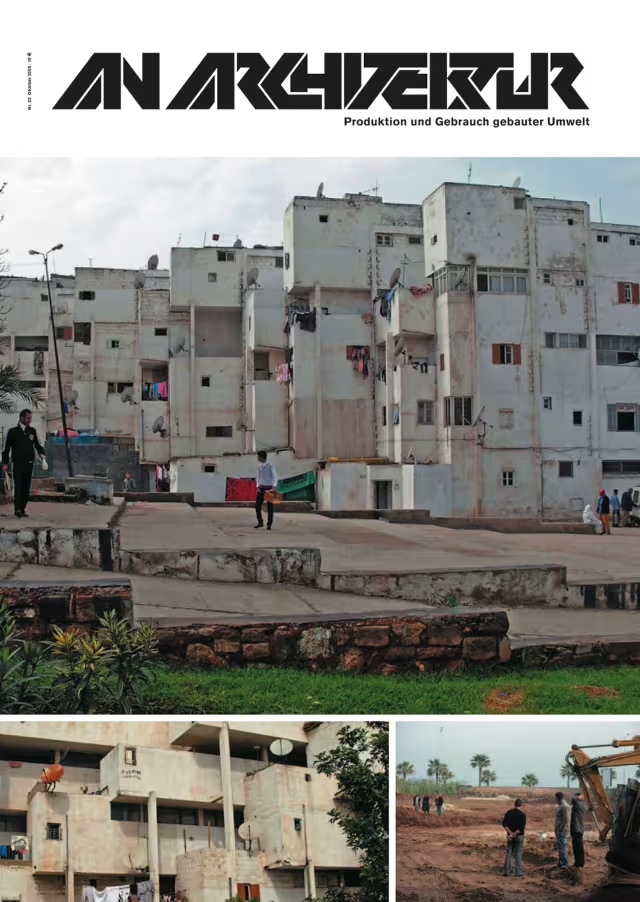
An Architektur 22
GAMMA Grid, 1953. Das Ende des CIAM und die Bidonvilles Casablancas
The plans of European architects in North Africa during the 1950s and their studies of daily life and living practices in the local bidonvilles were, for a brief time, of central importance in CIAM’s debates on the redefinition of modernism. Despite their keen interest in the realities of life in Casablanca’s bidonvilles, which were examined in the GAMMA Grid, the architects ignored the colonial conditions of their research—the anti-colonial struggles and the regime’s repression. On the one hand, this study opened up the discussion about an architecture that takes into account the local context, process, and users; on the other hand, it exemplifies the dilemma of postwar modernism, which was largely unable to provide anything other than aesthetic responses to social conflicts and political questions.
Featuring the reconstructed GAMMA Grid of the 9th CIAM and accompanying texts by Tom Avermaete, Marion von Osten, and Daniel Weiss.
With the kind support of the Haus der Kulturen der Welt, Berlin, and the Photothèque of the École Nationale d’Architecture de Rabat, Morocco.