For the best view of this page, we recommend turning your device to portrait orientation.
Thank you!
Gambo Rahima
Rahima Gambo is a multimedia artist. She studied social sciences in Manchester and London and journalism in New York City. After working as a photojournalist, she returned to Abuja, Nigeria, and began her artistic career with videos embedded in spatial installations that incorporate drawings, photographs, found objects, and plants.
Goldschmidtböing Sebastian
Sebastian Goldschmidtböing is a designer and researcher who lives and works in Cologne and Essen. He has a background as a master craftsman and several years of experience in research and development for the German automotive industry. He studied design at the Design Academy Eindhoven (BDes) and at the Berlin University of the Arts (M.A.). He has worked for design studios such as Aldo Bakker Studio (Amsterdam) and Studioilse (London). Since 2017, Sebastian Goldschmidtböing has been researching, working, and teaching at the Faculty of Industrial Design at the Folkwang University of the Arts in Essen.
Goll Philipp
Philipp Goll completed studies in media studies, Slavic studies, and European ethnology, as well as a Ph.D. in cultural studies. He is a freelance author and cultural researcher, inspired by artistic research, non-hegemonic knowledge practices, and dance.

Göngrich Erik
Erik Göngrich is an artist, architect, and curator. His sculptures, performances, installations, photographs, and publications reflect on the uses and transformations of urban space. Together with Berlin’s Mitkunstzentrale at the Haus der Statistik, he initiated a workshop for collective knowledge production. By recycling materials, ideas, and stories, his works address material cycles, art, the public sphere, and society in times of climate emergency.
Goodbun Jon
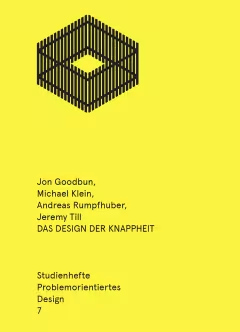
Jon Goodbun teaches at the Royal College of Art in London (MA Environmental Architecture), at the University of Westminster (MSc Advanced Environmental Design), and at UCL Bartlett (MArch). His publications include contributions on ecological systems theory, spatial knowledge, and the architecture of the extended mind.
Görlich Matthias
Matthias Görlich is a communication designer. He is a professor of Communication Design/Information Design at Burg Giebichenstein University of Art and Design Halle. Since 2000, he has been working with his studio in the fields of design and concept development for, among others, various art and cultural institutions in Germany and abroad, UNRWA (United Nations) in Jordan, Estudio Teddy Cruz in San Diego, and Cohabitation Strategies in New York. He is co-editor of “Institution Building” on spatial strategies of art institutions (with Nikolaus Hirsch, Philipp Misselwitz, and Markus Miessen) as well as the “Civic City Cahiers” on the role of design in the development of a social city (with Jesko Fezer). At adocs Verlag, he is co-editor of the series “Studienhefte problemorientiertes Design".
Griesenberg Justus
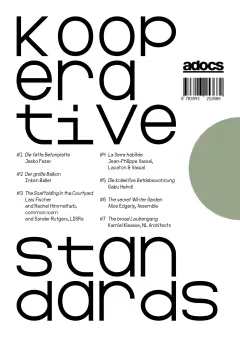
Justus Griesenberg is an architect. As a member of the Architecture and City department at HafenCity University Hamburg, he developed “Cooperative Standards” for situational architecture together with Marieke Behne and Christoph Heinemann.
Grob Markus
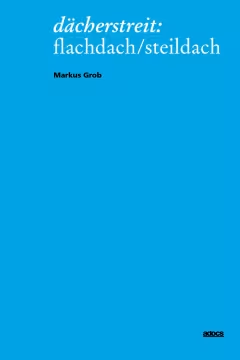
Markus Grob (1952–2021) traveled to Afghanistan in 1972/73, began studying Islamic Studies (which he did not complete), and traveled to Egypt in 1976/77. Starting in 1978, he studied architecture in Zurich; in 1984, he received his diploma from ETH and began his first practice with the renovation of Haus S. in Zug. From 1988 onward, he worked in Vienna as an architect in Adolf Krischanitz’s studio. In 1996, he was at the Akademie Schloss Solitude in Stuttgart, after which he was appointed to the professorship of architecture at the HFG Karlsruhe and collaborated with an architectural firm in Zurich. Since 1999, he created stage installations for the performance group "Die Bairishe Geisha" in Munich; in 2001, he completed a residential renovation in Barcelona; in 2004, he curated the exhibition “Kannitverstan” at the Badischer Kunstverein in Karlsruhe; and in 2008, he oversaw the renovation of a townhouse in Hamburg-St. Pauli. In 2012/13, he gave a winter lecture at the Weißensee Academy of Art on the relationship between architecture, urban space, and politics in the periods 1789 ff., 1918 ff., and 1948 ff. Publications: “Tun der Architektur,” Grundzüge der Architekturtheorie, Edition Solitude 1996; “Gründe, dass es eine Stadt nicht mehr geben kann,” on the problem of post-feudal urban planning, Raketenstation Hombroich 2004.
Grotz Kathrin
Kathrin Grotz has been Deputy Director of the Institute for Museum Research at the State Museums of Berlin—Prussian Cultural Heritage Foundation since 2020.