For the best view of this page, we recommend turning your device to portrait orientation.
Thank you!
Scholz Markus
Markus Scholz studied social work with foreign nationals in a pilot program in Hamburg before turning to photojournalism as a self-taught photographer. First as a freelance theater photographer, then as a staff editor and photographer for *taz-Hamburg*, he documented events in the greater Hamburg area. Today, he is once again working as a freelance photographer for the German Press Agency (dpa) throughout northern Germany. What began as a journalistic photo assignment titled “THE MISSION” on an otherwise uneventful Sunday afternoon in 1997 turned into a project lasting several years, marked by solidarity and personal growth.
Softić Adnan
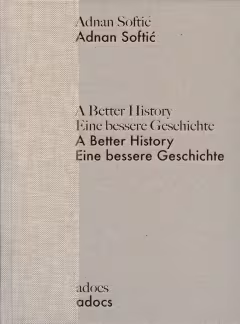
Adnan Softić is an author, visual artist, and director. He studied film and aesthetics at the HFBK Hamburg. His work explores historical themes and issues of the politics of memory. As the artist duo “Studio Softić,” together with Nina Softić, they have presented numerous installations and multimedia exhibitions both in Germany and abroad. In 2016–2017, they received the Villa Massimo Fellowship in Rome.
Sollfrank Cornelia
Cornelia Sollfrank is an artist, researcher, and author. Recurring themes in her artistic and scholarly practice include digital cultures, new forms of (political) self-organization, critical authorship, the aesthetics of the commons, and techno-feminist practice and theory.
Sonjasdotter Åsa
Åsa Sonjasdotter is an artist, re-searcher, writer, and social organiser, living on the island of Ven, Sweden, and in the city of Berlin, Germany.
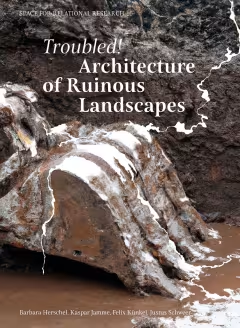
Space for Relational Research
Barbara Herschel, Kaspar Jamme, Felix Künkel, and Justus Schweer) bring together experience in spatial practices such as architecture, landscape architecture, urban planning, academic teaching, collaboration with civil society actors, and public administration.They understand relational research as a way to examine space as a network of relationships, dynamics, and processes. With the founding of the Space of Relational Research, they seek to establish a critical research practice that traces connections in space, questions the boundaries of architecture, and proposes new fields of work and collaborations.
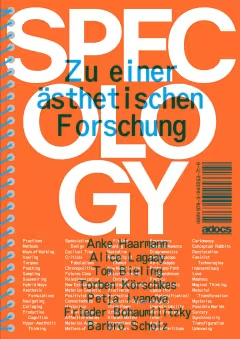
SpecSpace
Speculative Space (SpecSpace for short) was an experimental lab at the Center for Design Research at HAW Hamburg (2020–2023). The lab operated between physical and virtual space. In both, six or more hybrid designers, philosophers, and artists speculated on the rhizomatic relationship between design and research. SpecSpace are Anke Haarmann, Alice Lagaay, Tom Bieling, Torben Körschkes, Petja Ivanova, Frieder Bohaumilitzky and Barbro Scholz.
Stalder Felix
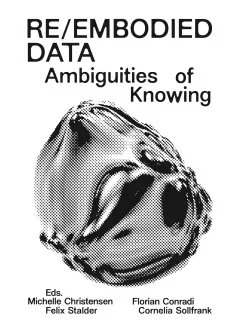
Felix Stalder is a professor of Digital Culture at the Zurich University of the Arts and led the research project “Latent Spaces – Performing Ambiguous Data.” His work focuses on the intersections of cultural, political, technological, and ecological dynamics.
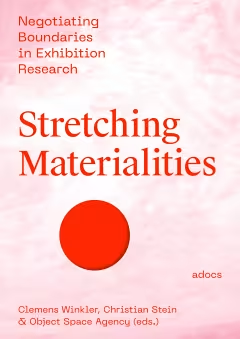
Stein Christian
Christian Stein is a postdoc at the Cluster of Excellence “Matters of Activity.” With a background in German studies and computer science, he combines technical and humanities perspectives. As a co-founder of gamelab.berlin, among other roles, he develops playful, interactive formats for knowledge transfer and conducts research on interface theory.
Steyerl Hito
Hito Steyerl is an artist and professor of Contemporary Digital Media at the Academy of Fine Arts in Munich. Her work has been exhibited at venues including the Venice Biennale, the Museum of Contemporary Art in Los Angeles, and the Museum of Modern Art in New York. In her texts, performances, and essayistic documentary films, Hito Steyerl explores (digital) image production, postcolonial critique, and feminist logic of representation.
Strack Laura
Laura Strack studied theater studies, Romance languages, and literary translation in Bochum, Düsseldorf, Palermo, and Tours. Today, she works at the intersection of theater, text, and theory. She is particularly interested in (conceptual) figures of the common, in social movements and critical forms, in theater as a place and in various spaces (e.g., city and countryside), in artistic ways of writing about finitude, and in translation as an existential-aesthetic practice. She translates literary and theoretical texts from French and Italian.