An Architektur 11–13
Theorie und Praxis der Kartografie
An Architektur 11
Material on: Brian Harley, The Deconstruction of the Map
“Brian Harley’s decisive contribution to cartographic science was to demonstrate that maps are more than just cleverly constructed artifacts with geographical contours. Drawing on approaches from art history and literary studies, he made us aware of the hidden messages in these social documents: an ‘eloquent silence,’ signs and symbols with subliminal statements that, mostly unacknowledged by their authors, reflect cultural values. Maps are, as Harley emphasized, more than passive mirrors of landscape and society; they are powerful agents of domination and instruments of propaganda.”
–From the obituary by Paul Laxton, in: The Independent, Dec. 27, 1991
Brian Harley’s text was translated into German for the first time, with a text by Denis Cosgrove.
An Architektur 12
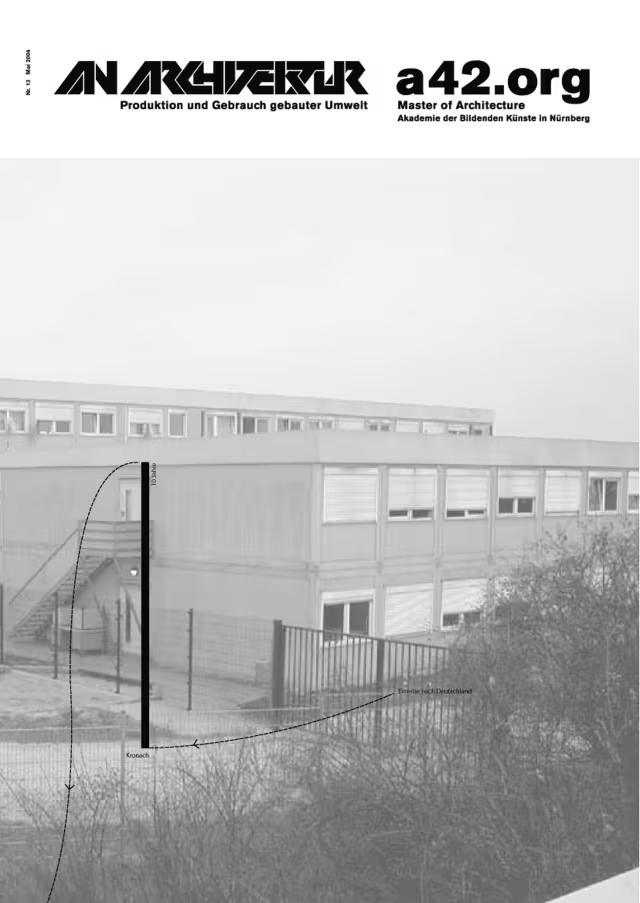
Geography of the Fürth Departure Center
“As of [date], you are to take up residence in the following shared accommodation. You are not in possession of passport documents, and therefore the state obligated to accept you cannot be determined. (...) The measures now being carried out at the aforementioned facility to obtain a travel document cannot be delayed, as you no longer have the right to remain in Germany and, furthermore, you are supporting yourself with public funds, thereby placing a special burden on the state beyond your unlawful stay. There is therefore a public interest in taking immediate measures to terminate your stay.”
–Standard official letter from the Foreigners’ Office regarding admission to a departure center
With thematic maps and diagrams, in collaboration with a42.org / students in the Master’s program in Architecture at the Academy of Fine Arts in Nuremberg and Res Publica.
An Architektur 13
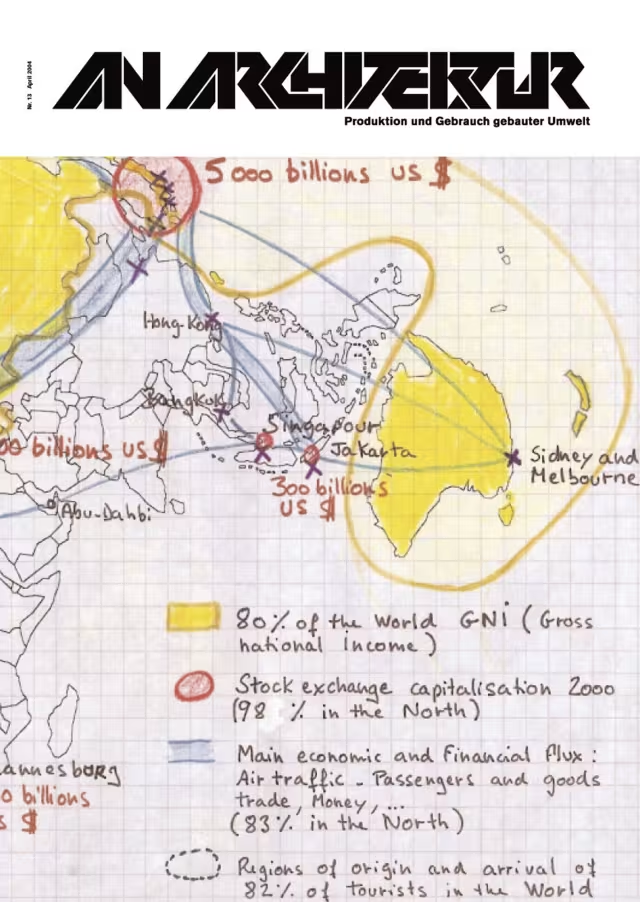
Rekacewicz: Maps on Globalization
“As soon as you map geographical, economic, or demographic data, you are being political, because you necessarily have to make a selection. Vast territories can be represented on an A4 sheet. To do this, you have to synthesize, omit, regroup, and simplify information. And of course, one always has an opinion: If we assume that we are part of the anti-capitalist and anti-globalization movement, then it is our intention, for example, to highlight social injustice and unequal access to resources.”
–Philippe Rekacewicz
With design sketches by and an interview with Philippe Rekacewicz.