An Architektur 19–21
Community Design. Involvement and Architecture in the US since 1963
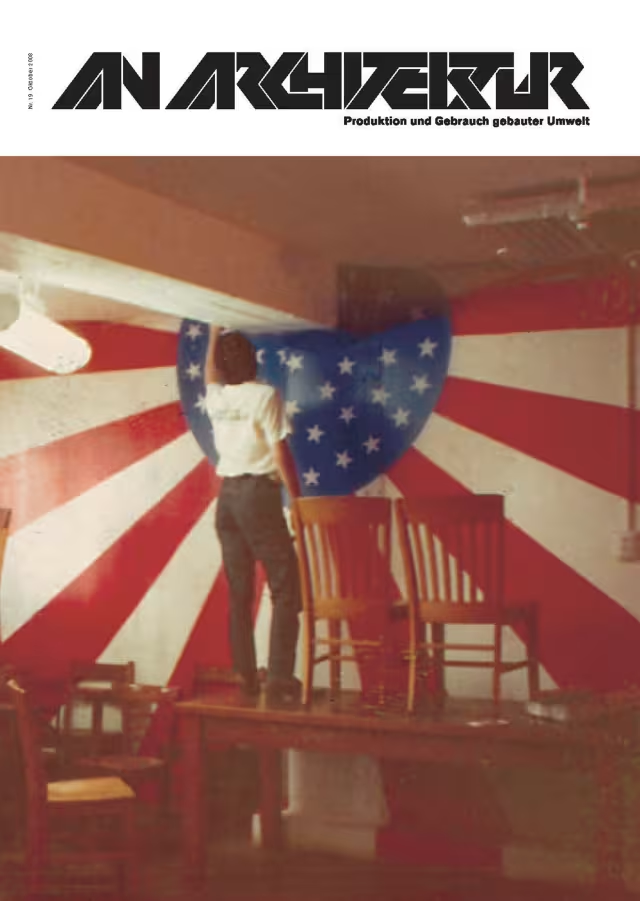
An Architektur 19
Community Design: Projects
“Community Design” refers to a socially engaged architectural and planning practice that has developed a self-organized and participatory approach over the past 40 years. Its potential as an oppositional architectural practice rests not only on its distinct ability to serve people overlooked by mainstream spatial production, but also on its reflective, at times critical, stance toward the demands of capitalist spatial production.
Featuring material and descriptions of more than 50 historical and contemporary Community Design Centers: ARCH (The Architects Renewal Committee in Harlem), Pratt Center for Community Development, The Real Great Society, Architecture 2001, Community Design Associates, Community Based Projects, Urban Planning Aid, San Francisco Community Design Center, TAR (The Architects’ Resistance), Urban Design Group, Architects Workshop, Community Design Center of Pittsburgh, Los Angeles Community Design Center, Metro Link, Neighborhood Design Center, Urban Deadline, Assist, Community Design Center of Minnesota, Community Development Group, Troy Architectural Program, Urban Field Service, Young Great Society Building Foundation, Cleveland Design Center, Environmental Works, Design Coalition, SCI-Arc Community Design Program, Asian Neighborhood Design, Planners Network, Urban Ecology, ACD (Association for Community Design), Community Design Center of Atlanta, Carl Small Town Center, ADPSR (Architects/Designers/Planners for Social Responsibility), Cleveland Urban Design Collaborative, City College Architecture Center, BaSiC Initiative, Community Design Collaborative, Design Corps, Yale Urban Design Workshop, Archeworks, Rural Studio, City Design Center, Detroit Collaborative Design Center, Studio 804, CUP (Center for Urban Pedagogy), Metropolitan Design Center, Hamer Center for Community Design, Estudio Teddy Cruz, College of Architecture and Planning: Indianapolis Center, Hester Street Collaborative, Charlottesville Community Design Center, Austin Community Design and Development Center, Building Community Workshop, CITYbuild, and Gulf Coast Community Design Studio.
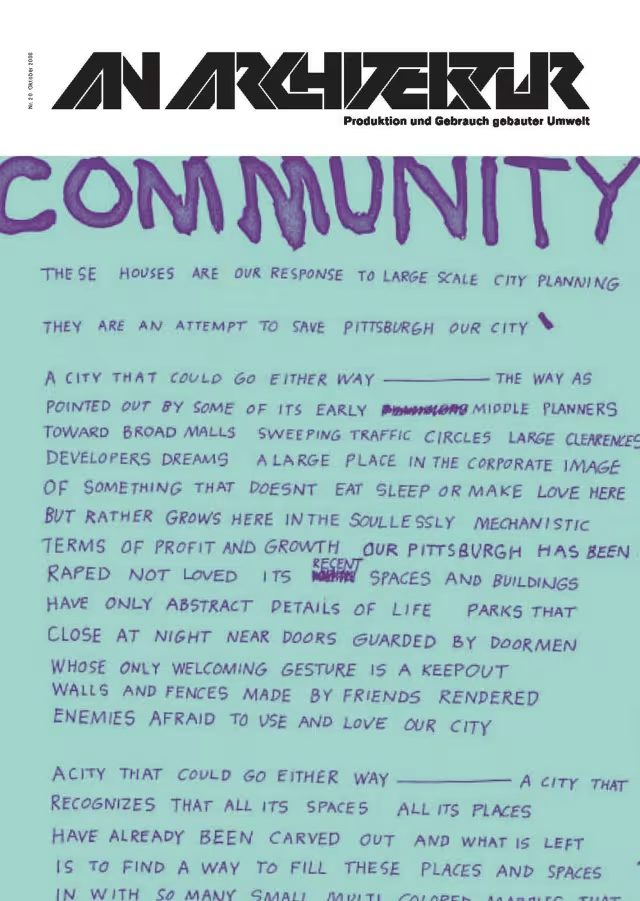
An Architektur 20
Community Design: Texts
“Always remember the first rule of power tactics: Power is not just what you possess, but what your opponent thinks you have. The second rule is: Never leave the realm of your own people’s experience. If an action or tactic lies outside the people’s realm of experience, it leads to confusion, fear, and hesitation. (…) The third rule is: Whenever possible, leave the opponent’s realm of experience. Here, the goal is precisely to create confusion, fear, and hesitation.”
–Saul Alinsky, Rules for Radicals
With texts by Peter Aeschbacher, Saul Alinsky, Mary C. Comerio, Paul Davidoff, Cheryl Doble, Kathy Dorgan, Roberta Feldman, Lisa R. Peattie, Frances Fox Piven, Henry Sanoff, and Anthony W. Schuman.
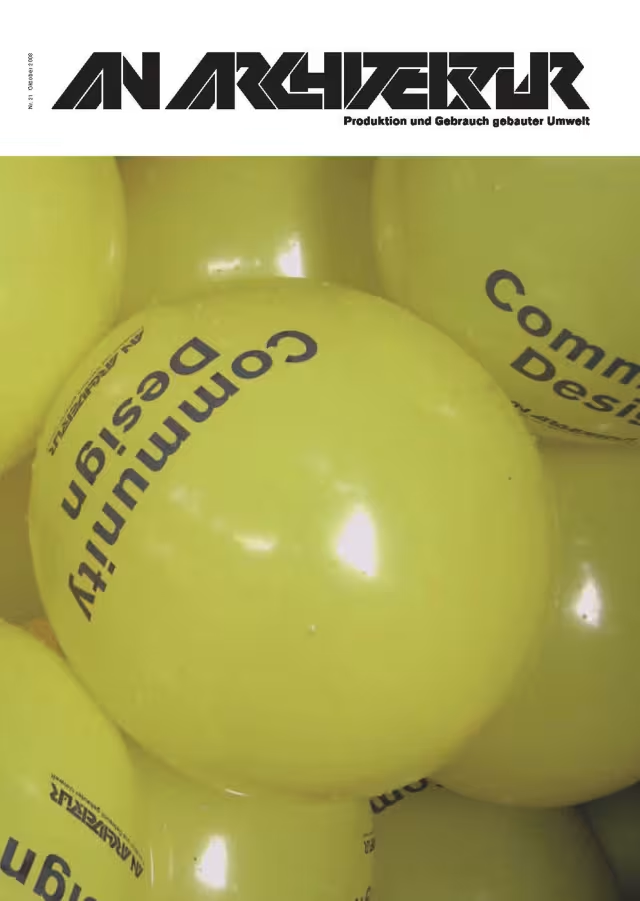
An Architektur 21
Community Design: Public Interviews
“In the U.S., social engagement is less visible, and particularly at architecture schools and in architectural discourse, the idea that architecture could play a role in politics is dismissed. How often have I heard: ‘We are architects. We design forms. The rest is a matter for sociologists, economists, and politicians.’ I consider this to be completely wrong.”
–Roberta Feldman
Interviews with Roberta Feldman (University of Illinois, Chicago) and Henry Sanoff (North Carolina State University, Raleigh): Consensus, Equality, Experts, and Good Design; and with Damon Rich (Center for Urban Pedagogy, New York) and Michael Rios (University of California, Davis): Education, Pluralist Planning, New Institutions, and Language.
The interviews were presented by arttransponder Berlin.