For the best view of this page, we recommend turning your device to portrait orientation.
Thank you!
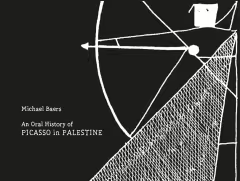
Baers Michael
Michael Baers is an artist and author whose work focuses on the intersections between artistic practice, institutional and state policy, and national and international politics. His works often emerge from oral traditions and other forms of research. In 2014, he completed his doctorate as part of the practice-oriented doctoral program at the Academy of Fine Arts in Vienna. Since 2020, Baers has been an associate researcher at the Leibniz Center for Modern Orient Studies (ZMO) in Berlin.
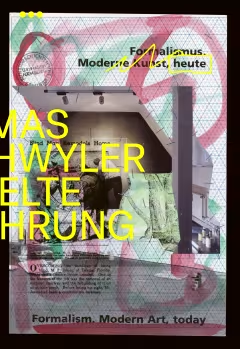
Baldischwyler Thomas
Thomas Baldischwyler works with a variety of media (music, film, photography, collage, painting, installation)—depending on the theme and context. His working process involves references to cultural-historical events in which the subjective frameworks of historiography are situated. His works have been featured in numerous national and international solo and group exhibitions. In 2010, he received the Westfälischer Kunstverein Münster’s Promotion Prize, and in 2017, the Hamburg Edwin Scharff Prize. After extended residencies in Basel, Rome, and Venice, he has been living and working in Hamburg again since 2022, where he runs, among other things, the artist-run record label Travel By Goods.
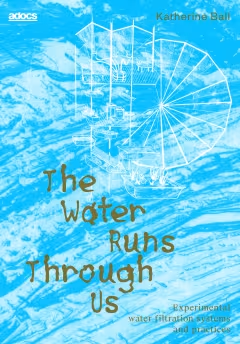
Ball Katherine
Katherine Ball is a habitat for fungi and bacteria located on planet Earth. Their artistic interventions practice the arts of living on a damaged planet and reimagine the infrastructure of everyday life. These have included: living in an off-grid floating island building mushroom filters to clean a polluted lake, bicycling across the USA looking for “solutions” to the climate crisis, and apprenticing with nature to learn the biological counterpart to civil disobedience.
Katherine has a Master in Fine Arts in Social Practice from Portland State University and studied at the School of Walls and Space in Copenhagen. Katherine is a founding member of Floating Berlin since its inception in 2018.
Bartoli Sandra
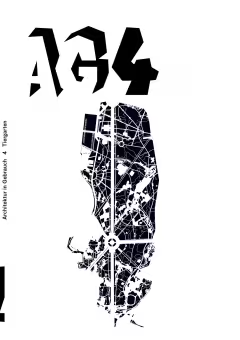
Sandra Bartoli is an architect and landscape architect. Her research focuses on places where nature and the city are intertwined, such as Berlin’s Tiergarten, a transgressive example of a site that leads to new definitions and models of what constitutes “urban” in the face of the challenges of the Anthropocene. In 2019, Bartoli co-edited the book *Tiergarten. Landscape of Transgression” (Park Books). From 2017 to 2018, Bartoli began working on the research topic “The Future Natural History of the City” as an endowed professor for Visionary Urban Forms at the Institute for Art and Architecture at the Academy of Fine Arts Vienna. Bartoli is currently a full professor at the Faculty of Architecture at Munich University of Applied Sciences.
Becker Anke
Anke Becker is a visual artist and has been working in Berlin since 1991. Her artistic practice ranges from conceptual drawings and installations to visual poetry and participatory projects. She explores the presence and absence of language, line, and text in diverse ways. She is the founder of the international art and exhibition project Anonyme Zeichner, runs the visual poetry blog Economic Words, and is a founding member of the Damensalon, a network of female artists featuring monthly salon evenings with rotating guests.

Becker Jochen
Jochen Becker works as an author, curator, and lecturer, and is a co-founder of metroZones | Center for Urban Affairs and the station urbaner kulturen/nGbK. He curated “Chinafrika. under construction” (Graz, Leipzig, Weimar, Shenzhen, Nuremberg) and provided cultural-political, conceptual, and curatorial support for the relocation of Düsseldorf’s FFT Theater (2017–2022). Becker is active in the Urbane Praxis initiative.
Behne Marieke
Marieke Behne studied architecture at HafenCity University Hamburg and worked there in the Architecture and City department. She earned her doctorate on the modes of operation of experiential knowledge in architecture using the example of self-organized housing projects and is a co-founder of projektbuero Hamburg.
Bitter / Weber
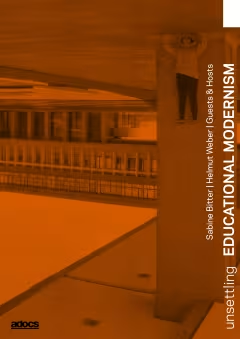
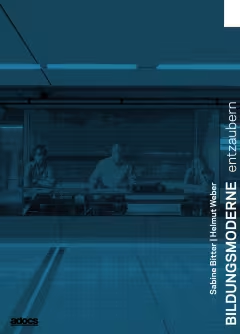
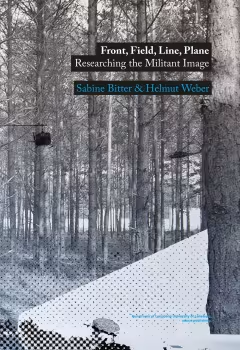
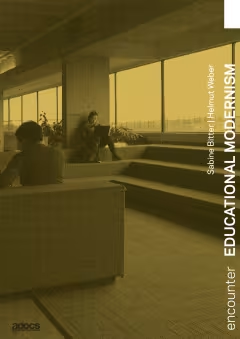
The artists Sabine Bitter & Helmut Weber, who live in Vancouver and Vienna, have been working since 1993 on projects that deal with cities, architecture, and the politics of representation and space. They work with the media of photography and video. In their research-oriented practice, they examine specific moments and logics of global urban change as they manifest in neighborhoods, architecture, and everyday life. Since 2004, they have been members of the cultural research collective Urban Subjects, together with Jeff Derksen.
Bohaumlitzky Frieder
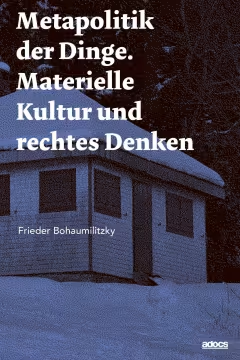
Frieder Bohaumlitzky is a designer, curator, and political scientist. He designs, researches, and teaches on the political relevance of material culture. From 2017 to 2019, he was part of the Friedrich von Borries Project Office in Berlin, and from 2020 to 2023, he served as a research assistant at the Center for Design Research at HAW Hamburg. Since 2023, he has been running studio lose together with Ina Römling and Torben Kärschke, which collaboratively and speculatively explores the design of sociopolitical spaces of negotiation.
Brandolini Andreas
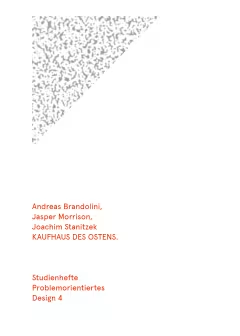
Andreas Brandolini studied architecture at the Technical University of Berlin (1973–1979) and worked as a designer and architect at Produktentwicklung Roericht in Ulm (1979–1981). Brandolini was a co-founder of the avant-garde New German Design movement of the 1980s; he set new standards with his “German Living Room” at documenta 8. From 1986 to 1993, he ran his own design studio in Berlin. In the late 1980s, Brandolini founded the firm “Utilism International” with Jasper Morrison and Axel Kufus, which focused on exhibition design and urban planning. Brandolini was co-editor of “Kaufhaus des Ostens” in 1984.
Brisson-Darveau Amélie
Amélie Brisson-Darveau is an artist, researcher, and doctoral candidate based in Tiohtiˆ:ke/Montréal. In her work, she explores the structural properties of shadows in literature, art, performance, cinema, and urbanism.
Brunner Christoph
Christoph Brunner has a background in cultural and media studies as well as continental philosophy. He investigates the relationships between media, aesthetics, and politics, with a particular interest in post- and decolonial critiques of Western thought and a posthumanist decentering of the individual. He was a junior professor of cultural theory at Leuphana University Lüneburg (2016–2023); since 2023, he has been an assistant professor at the School of Philosophy at Erasmus University Rotterdam.
Buckermann Paul
Paul Buckermann ist Soziologe, Kulturmanager und Autor und beschäftigt sich mit den Schnittstellen zwischen Kunst, Wissenschaft und Politik. Neben seiner wissenschaftlichen Tätigkeit ist er als Kulturjournalist tätig und verfasst Essays und Rezensionen für Publikationen wie u.a. WOZ, Jungle World, Texte zur Kunst. Als Kulturmanager und Kulturvermittler hat er in Institutionen wie Artists Unlimited, Neubad Luzern, Heidelberger Kunstverein, Oval Office Bar, KoFabrik und Künstlerhaus Dortmund gearbeitet.
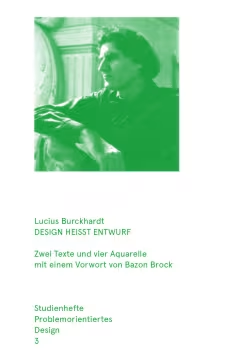
Burckhardt Lucius
Lucius Burckhardt (1925–2003) held a Ph.D. in sociology. After serving as a visiting lecturer at the Ulm School of Design in 1959, he held several teaching positions and later served as a visiting lecturer in sociology at the Department of Architecture of the Swiss Federal Institute of Technology in Zurich from 1961 to 1973. At the same time, he served as editor-in-chief of the journal “Werk” from 1962 to 1972. From 1976 to 1983, Lucius Burckhardt was the first chairman of the German Werkbund, and from 1973 onward he taught as a professor of the socio-economics of urban systems at the University of Kassel. From 1987 to 1989, he was a member of the founding advisory board of the Saar College of Fine Arts, and from 1992 to 1994, he served as founding dean of the Faculty of Design at the Bauhaus University Weimar. His work was honored in 1994 with the Hessian Culture Prize for outstanding achievements in art, science, and cultural education, in 1995 with the Federal Prize for Design Promotion, and in 2001 with the Swiss Design Prize.