- new

For the best view of this page, we recommend turning your device to portrait orientation.
Thank you!
Oleksiy Radynski is a Ukrainian filmmaker, author, and co-founder of Kinotron Group. His films experiment with documentary forms and practices of political cinema. They have been shown at film festivals and in exhibition contexts worldwide. Radynski is currently focusing on investigating the toxic legacy of Russian settler colonialism in Northern Eurasia and its imperial wars, including the ongoing Russian invasion of Ukraine.
Patricia Rahemipour has been Director of the Institute for Museum Research at the State Museums of Berlin—Prussian Cultural Heritage Foundation since 2019.
Andreas Reckwitz is a sociologist and cultural studies scholar. He is a professor of general sociology and cultural sociology at Humboldt University in Berlin. Reckwitz has been instrumental in advancing the development of praxeology as a comprehensive social and cultural theory, a perspective that also underpins his influential work on subjectivation and creativity.
Johan Redström is a professor of design at the Institute of Design at Umeå University in Sweden. Previously, he was director of studies at the Interactive Institute and held a research professorship at the Center for Design Research at the Royal Academy of Fine Arts, School of Architecture, Denmark. In 2006, he received the Design Studies Award, and in 2009, he was elected a Fellow of the Design Research Society.
Marinus Reuter is a photographer, author, and researcher. He researches post-phenomenological aesthetics and documentary photography and examines the common ground on which the mismatch between socially expanded regimes of representation and singular positioning manifests itself in politics and aesthetics. His own work focuses on logistics and service capital and a sociality dominated by distributive techniques.
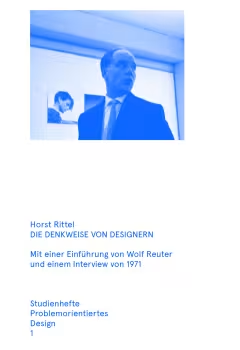
Horst Rittel (1930–1990) studied mathematics and theoretical physics in Göttingen from 1949 to 1954 and subsequently worked as a mathematician and physicist at Maschinenfabrik Deutschland AG in Dortmund until 1957. In 1958, he joined the Social Research Center at the University of Münster (WWU), where he studied mathematics and sociology. From 1958 to 1963, he taught methodology, information theory, and mathematical operations analysis at the Ulm School of Design (HfG Ulm), among other subjects, and became one of the leading voices advocating for a scientific analysis of design. Beginning in 1961, Rittel was a member of the Study Group for Systems Research in Heidelberg, as well as the initiator and leading scientist of numerous projects for the German Bundestag, the Bundesrat, and the OECD, among others. Following the 1962 Conference on Design Methods in London, Horst Rittel was one of the founding members of the Design Methods Movement. In 1963, he was appointed to the University of California, Berkeley, where he helped establish the Design Methods Group and the “DMG Journal” in 1967. From 1973 to 1990, Rittel was director and professor at the Institute for the Fundamentals of Planning at the University of Stuttgart.
Drehli Robnik is an essayist and theory consultant on politics, film, and history, as well as an edutainer, disc jockey, and music event organizer (Sonntag’sdisco). He is a (co-)editor of books on Siegfried Kracauer, the X-Men, and male violence in the domestic thriller (2022, with Joachim Schätz), as well as the author of monographs on anti-Nazi resistance, Jacques Rancière, control horror cinema, pandemic feature films, and popular cinema and politics.
Jens Röhm (1968–2010) studied visual communication at the HFBK Hamburg. He worked as a musician and film sound engineer and was a co-founder of the composer collective Nelly Boyd, which collaborated with musicians such as Alvin Lucier and Phil Niblock.
Klaus Ronneberger (1950–2025) studied social pedagogy in Würzburg and worked in an alternative record store. In Frankfurt am Main, he studied cultural anthropology and European ethnology, sociology, and political science. After many years of collaboration at the Institute for Social Research in Frankfurt am Main, he worked as a freelance journalist. Although he did not pursue a traditional academic career, Ronneberger had a significant influence on critical urban studies and urban activist movements. He was a member of the urban research group “spacelab,” was involved in Frankfurt initiatives such as Nitribitt and Kanak Attak, and participated in research projects such as “Shrinking Cities.”
Michael Rottmann is an art and media scholar. He studied art education, art history, mathematics, and philosophy in Stuttgart, Vienna, and Berlin. He was a research assistant at the Ludwigsburg University of Education as well as a curator at mumok and the Vienna University of Technology. He subsequently worked at the DFG Research Training Group “Schriftbildlichkeit” at Freie Universität Berlin. There, he earned his doctorate in 2013 with a dissertation on the relationship between art in New York around 1960 and mathematics. He has taught in Vienna, Graz, and Linz. From 2018 to 2022, he was a senior researcher at the Academy of Art and Design Basel.
Andreas Rumpfhuber is an architect and theorist. His research focuses on the changing aesthetic practice of architecture in relation to new economies. He has served as a visiting and adjunct professor at institutions including the Muthesius Academy of Fine Arts in Kiel, the State Academy of Fine Arts in Stuttgart, the Vienna University of Technology, and the Academy of Fine Arts in Vienna. He currently teaches at the Institute for Architectural Theory and History of Architecture at the University of Innsbruck.
Joseph Rustom is an architect whose research focuses on urban history. In collaboration with Lebanese architectural firms, he has led several conservation and restoration projects, including the Omari Mosque and the Archaeological Museum at the American University of Beirut, as well as the Soap Museum in Saida. He taught urban history and cultural heritage at the Faculty of Architecture of the Lebanese Academy of Fine Arts. He is currently the director of the library at Saint Joseph University in Beirut.